NCLT Mumbai dismisses Bank of Maharashtra’s insolvency plea against personal guarantor as time-barred
Court / Authority
Income Tax Tribunal
Update / Judgement Date
27 Jun 2026
Source
WCP News Bulletin
Author
Manas Yadav — WCP Legal Desk
Reading Time
2 min read
View Count
2
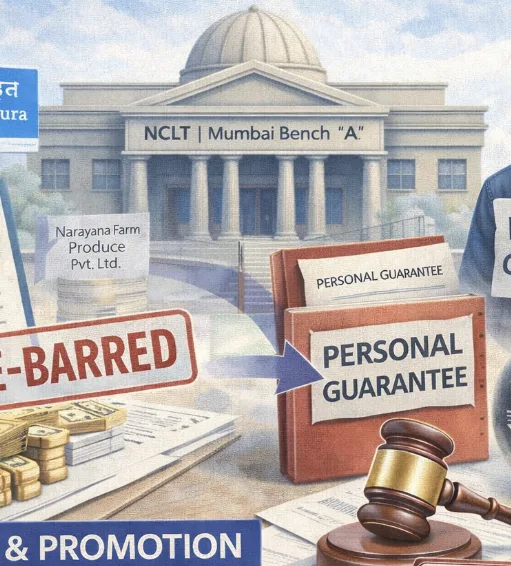
The Mumbai Bench of the National Company Law Tribunal (Court III) has dismissed a petition filed by Bank of Maharashtra seeking initiation of insolvency resolution proceedings against Sunil Kumar Prabhakaran Menon, the personal guarantor of Narayana Farm Produce Private Limited, holding that the application was ex facie barred by limitation.
Background
The petition was filed under Section 95 read with Section 100 of the Insolvency and Bankruptcy Code, 2016, in respect of an alleged default amounting to approximately ₹228.48 crore. The Financial Creditor relied on loan facilities extended to the principal borrower in 2010, secured by a continuing personal guarantee executed by the respondent. While the Tribunal noted that the existence of debt and execution of the personal guarantee were undisputed, the core issue before the Bench was whether the petition had been filed within the prescribed limitation period. The Tribunal observed that the personal guarantee stood invoked through a demand notice issued under Section 13(2) of the SARFAESI Act on August 20, 2013, which granted 60 days for repayment. Accordingly, the cause of action arose on October 19, 2013.
Tribunals Finding
The Bench held that the limitation period of three years, as prescribed under Article 137 of the Limitation Act, 1963, expired on October 18, 2016. Since the Section 95 petition was filed only on September 14, 2022, nearly six years after expiry of limitation, the application was not maintainable. Rejecting the Financial Creditor’s reliance on subsequent correspondence and demand notices, the Tribunal clarified that a Form-B demand notice under the IBC cannot be treated as a valid invocation of a personal guarantee for limitation purposes. The Bench also relied on the Supreme Court’s reiteration of the mandatory nature of limitation law and its own earlier decision involving another guarantor for the same loan transaction.
Consequently, the Tribunal dismissed the petition, held that no insolvency resolution process stood initiated against the personal guarantor, and declared that the moratorium under Section 96 of the Code would cease to operate.
Full Judgement / Attachment
Full Judgement
Frequently asked questions about Income Tax Tribunal
- What is the Income Tax Appellate Tribunal (ITAT)?
- The ITAT, set up in 1941, is the second appellate authority in direct tax matters and the final fact-finding body. It hears appeals against orders of the Commissioner (Appeals) and certain other authorities, through benches across India.
- What is the time limit to file an appeal before the ITAT?
- An appeal must be filed within two months from the end of the month in which the order is communicated. This rule has applied since 1 October 2024 and continues under the Income-tax Act, 2025. The Tribunal can condone delay for sufficient cause.
- Can the ITAT stay a tax demand?
- Yes. The Tribunal can stay recovery of a disputed demand while an appeal is pending, usually on deposit of a part of the demand or furnishing security. Stays are granted for a limited period, and the appeal is expected to be decided within it.
- Where does an appeal go after the ITAT?
- An appeal against an ITAT order lies to the High Court, but only on a substantial question of law. A further appeal lies to the Supreme Court.
- How can White Collar Professional help with a ITAT matter?
- Post your requirement on White Collar Professional to receive proposals from verified Chartered Accountants and tax Advocates, compare them, and pay securely through the platform. This page also tracks the latest ITAT ITAT orders as they are reported.









