Redevelopment Disputes and the Co-operative Court: Bombay High Court Lays Down Three-Condition Test Under Section 91 MCS Act, Bars Disputes Once Third-Party Rights Are Created
Court / Authority
Bombay High Court
Update / Judgement Date
14 Oct 2026
Date of Publication
16 Oct 2026
Case No.
WP 12770/2026
Source
WCP News Bulletin
Author
Arshee Saifi — WCP Legal Desk
Reading Time
9 min read
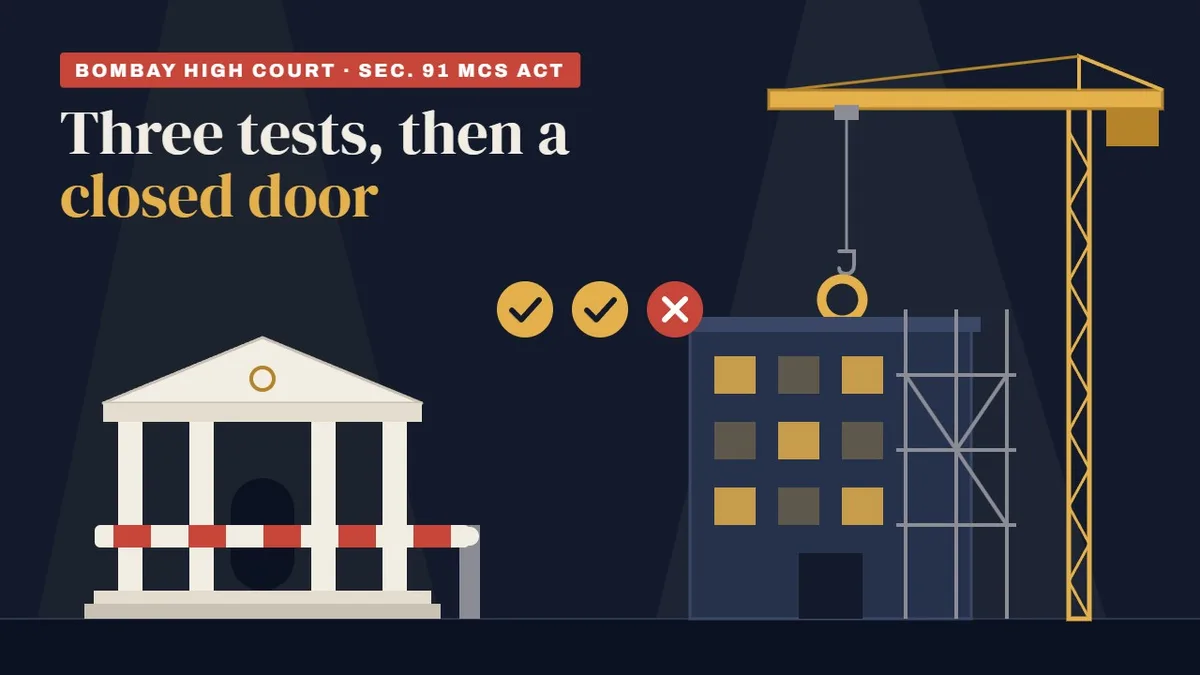
Key Proposition: A dispute under Section 91 of the MCS Act challenging any decision in a society’s redevelopment process lies before the Co-operative Court only where the society has amended its bye-laws after the 2019 Amendment to include redevelopment as its business, no right, title or interest has yet been created in favour of a third party in the society’s property, and both facts are specifically pleaded; otherwise the dispute is liable to rejection under Order VII Rule 11 CPC.
Maharashtra Co-operative Societies Act, 1960 – Section 91 – Redevelopment – Whether a dispute challenging the redevelopment process lies before the Co-operative Court where the bye-laws have not been amended to make redevelopment the business of the society? – Held, no. (Paras 33–36)
MCS Act – Section 94(3)(a) – Third-party rights – Whether a Development Manager and Financer who acquired interest before the dispute was filed can be impleaded so as to sustain the dispute? – Held, no; the remedy is a civil suit. (Paras 28, 36)
Code of Civil Procedure, 1908 – Order VII Rule 11 – Whether a dispute framed as seeking only disclosure of documents and compliance with guidelines escapes the bar when redevelopment is at its heart? – Held, no. (Paras 18, 24, 30)
Interim injunction – Whether temporary injunction can be granted once the dispute itself is not maintainable? – Held, no; writ petition infructuous. (Para 39)
Background / Synopsis :
The Respondent society has 54 members and owns Building No. 25, built in 1956 at Khernagar, Bandra East, Mumbai, on land it holds as lessee under Deeds dated 22 December 2012.
On 25 August 2018 its Special General Body Meeting resolved to self-develop the building under Regulation 33(5) of DCPR 2034; M/s. Dilip Sanghvi Consultants was appointed PMC, and MHADA issued an offer letter on 29 December 2021.
The Petitioners alleged an earlier cancelled developer appointment, repeated rejection of proposals in 2021–22, a single tender from M/s. Vinca Realtors Pvt. Ltd. on 8 December 2022, and a conflict of interest because the developer’s director is the brother of a member.
A notarised Development Manager Agreement dated 8 October 2024 and a Finance Agreement dated 31 March 2025 (registered on 7 April 2025) were executed; the Petitioners alleged these were without General Body approval and leave members only 29% of the constructed area while 71% goes to the Development Manager/Financer.
Issues For Consideration :
Whether the Co-operative Appellate Court erred in rejecting the Dispute under Order VII Rule 11 CPC as not maintainable under Section 91 of the MCS Act.
What conditions must be satisfied for a dispute concerning a society’s redevelopment process to be maintainable before the Co-operative Court, on a harmonious reading of Parimal H. Solanki, Baliram Misal and Anthony Carneiro.
Whether the Petitioners were entitled to a temporary injunction against the redevelopment process.
Submissions Of Parties :
Petitioners (Members):
The Dispute concerns the management and business of the society and seeks only disclosure of documents and compliance with Government guidelines, which no civil court can grant.
The need for adjudication is shown by the General Body Meeting of 19 February 2023, where a member’s request for the Development Manager’s balance sheets was deflected.
The Development Manager is neither a necessary nor a proper party; Section 94(3)(a) of the MCS Act does not apply, and the Dispute is maintainable under Section 91.
Without an injunction the Dispute would be rendered infructuous by further redevelopment steps.
Respondents (Society and office-bearers):
For a redevelopment dispute to lie under Section 91, the plaint must positively state that the bye-laws were amended after the 2019 Amendment to include redevelopment as business, and that no document creating rights in society property has been executed; both are absent.
Court's Observations & Analysis :
- Re: Issue (i): Rejection of the Dispute under Order VII Rule 11
- The plaint must be read holistically; despite framing prayers (b) and (c) as disclosure and compliance, the real grievance is the implementation of the self-redevelopment project, and prayer (a) expressly seeks to stop the project (Paras 18, 24).
- Section 91 requires both that the parties fall within Clauses (a) to (e) of Section 91(1) and that the subject matter touches the business of the society (Para 25).
- Following Baliram Misal, a composite challenge to resolutions and to development documents must be brought before the same forum, which is the Civil Court (Para 26).
- The DMA and Finance Agreement, produced with the Dispute, created rights in the built-up area in favour of the Development Manager and Financer before the Dispute was filed; under Section 94(3)(a) as interpreted in Margret Almeida they cannot be impleaded, though the outcome would affect them (Para 28).
- Anthony Carneiro bars disputants from ‘cleverly confining’ the challenge where redevelopment is at the heart of the controversy and third-party rights have intervened; there, no developer had been appointed, so the dispute was maintainable – unlike here (Paras 29–30).
- Held: The Dispute was rightly rejected under Order VII Rule 11 CPC. (Paras 30, 38)
Decision & Directions :
- Writ Petition No. 12770 of 2026 and Writ Petition No. 11719 of 2026 dismissed; no order as to costs. (Para 40)
- The Co-operative Appellate Court’s orders dated 4 September 2026 (rejecting the Dispute) and 7 August 2026 (refusing injunction) stand; the Petitioners must pursue a civil suit. (Paras 38–39)
- Conditions laid down for maintaining a Section 91 dispute challenging any decision in a redevelopment process (Para 35):
1. Redevelopment must be included as business of the society by amending its bye-laws after the 2019 Amendments to the MCS Act.
2. No right, title or interest must have been created in favour of a third party in the society’s property.
3. Specific averments must be made in the Dispute Application about both these positions; if either is absent, the Dispute is liable to rejection under Order VII Rule 11 CPC (Paras 34, 36).
Legal Provisions Discussed & Precedents Cited :
- Maharashtra Co-operative Societies Act, 1960 (MCS Act) – Section 91 – disputes touching the constitution, management or business of a society; twin requirements of parties and subject matter.
- MCS Act – Section 94(3)(a) – a person who acquired interest in the society’s property before the dispute cannot be made a party to it.
- MCS Act – Chapter XIII-B, Sections 154B-1(17) and 154B-31 (2019 Amendment) – ‘housing society’ includes redevelopment as an object, but existing bye-laws continue until amended.
- MCS Act – Section 79A – directives on redevelopment, noted as excluded from Section 91(1)(c) in Parimal H. Solanki.
- Code of Civil Procedure, 1908 (CPC) – Order VII Rule 11 – rejection of plaint where the dispute is barred by law; Section 9 – plenary jurisdiction of civil courts.
- Development Control and Promotion Regulations, 2034 (DCPR 2034) – Regulation 33(5) – background to the self-redevelopment project.
- Doctrines applied: holistic reading of the plaint; bar on clever drafting to bring a claim within a forum’s jurisdiction.
- Margret Almeida v. Bombay Catholic Co-operative Society Ltd., (2012) 5 SCC 642 – Followed.
- Baliram Totaram Misal v. Saujanya Co-operative Housing Society Ltd., Civil Writ Petition No. 15791 of 2025, decided on 27 August 2026 – Followed.
- Parimal H. Solanki v. Bhoumik Co-operative Housing Society Ltd., Interim Application (L) No. 25993 of 2022, decided on 6 October 2022 – Followed.
- Anthony Irineus Carneiro v. Francis Colaco, Civil Writ Petition No. 9817 of 2026, decided on 18 September 2026 – Distinguished on facts; principle applied.
- Mohinder Kochar v. Mayfair Housing, (2012) 6 Bom CR 194 – Referred to.
- Maya Developers v. Rajkumar L. Nagda, (2016) 6 Bom CR 629 – Referred to.
- Vardhaman Developer Ltd. v. Thailambal CHS Ltd., Order dated 7 March 2011 in Notice of Motion No. 3274 of 2010 – Referred to.
Case Details :
- Case / Party Name: Ramesh K. Devadiga & Ors. v. Khernagar Nandadeep Co-operative Housing Society Ltd. & Ors.
- Case Number(s): Writ Petition No. 12770 of 2026 with Writ Petition No. 11719 of 2026
- Coram / Judges: Sandeep V. Marne, J. – Single Judge
- Counsel Appearances: For the Petitioners: Mr. Kunal Bhanage with Mr. Akshay Pawar, Mr. Faiz Ali Khan and Ms. Sarita Shetye. For the Respondents: Mr. Mayur Khandeparkar with Mr. Devansh Shah, Mr. Bishwajeet Mukherjee and Mr. Naman Gupta.
Disclaimer: This summary is an editorial aid and does not form part of the judgment. Refer to the original judgment before citing.
Full Judgement / Attachment
Full Judgement
Frequently asked questions about Bombay High Court
- Where does the Bombay High Court sit and which areas does it cover?
- The Bombay High Court has its principal seat in Mumbai, with benches at Nagpur, Chhatrapati Sambhajinagar (Aurangabad) and Goa, and a circuit bench at Kolhapur that began sitting on 18 August 2025. It has jurisdiction over Maharashtra, Goa and the Union Territory of Dadra and Nagar Haveli and Daman and Diu. Established in 1862, it is one of India's three oldest High Courts.
- How do I search Bombay High Court cases across Mumbai, Nagpur, Aurangabad, Goa and Kolhapur?
- The official website, bombayhighcourt.gov.in, lets you pick the bench (Principal Seat, Nagpur, Aurangabad, Goa or Kolhapur) before searching case status, cause lists and orders. Judgements are also on the eCourts Judgments portal (judgments.ecourts.gov.in).
- What is the Original Side and Commercial Division of the Bombay High Court?
- On its Original Side, the court hears high-value civil suits arising within Mumbai city, and its Commercial Division hears commercial disputes under the Commercial Courts Act, 2015. It also hears arbitration petitions, company and tax appeals, including those from the ITAT Mumbai, Pune, Nagpur and Panaji Benches.
- What is a Letters Patent Appeal in the Bombay High Court?
- In many matters, an order of a single judge can be challenged before a Division Bench by a Letters Patent Appeal under Clause 15 of the Letters Patent. Commercial matters follow the Commercial Courts Act route instead. Against a final judgement, the route is a Special Leave Petition under Article 136, ordinarily within 90 days.
- How can White Collar Professional help with a Bombay High Court matter?
- Post your requirement on White Collar Professional to receive proposals from verified Advocates, Chartered Accountants and Company Secretaries, compare them, and pay securely through the platform. This page also tracks the latest Bombay High Court judgements and legal updates as they are reported.