Jurisdiction and Compensation Assessment in Land Acquisition Cases: Key Takeaways from S. N. Desai Hospitalities & Developers LLP v. Deputy Collector
Court / Authority
Bombay High Court
Update / Judgement Date
15 Oct 2026
Date of Publication
18 Oct 2026
Source
WCP News Bulletin
Author
Pranjal Jha — WCP Legal Desk
Reading Time
4 min read
Case Header
- Case / Party Name: S. N. Desai Hospitalities & Developers LLP, Mumbai v. Deputy Collector (Land Acquisition Officer) No.7, Mumbai and another
- Court Name: High Court of Judicature at Bombay
- Case Number(s): First Appeal No. 268 of 2021 & First Appeal No. 541 of 2021
- Citation: Not available
- Coram / Judges: Manish Pitale & Shreeram V. Shirsat, JJ
- Judgment Authored By: Manish Pitale, J.
- Date of Decision: 15 October 2026
- Nature of Proceedings: Civil Appeal
- Counsel Appearances: Mr. Girish Godbole, Senior Advocate, a/w. team for MCGM; Mr. C. M. Korde, Senior Advocate, a/w. team for claimant; Mr. Dinesh J. Haldankar, AGP for the State.
- Outcome: Appeals partly allowed; impugned award modified.
- Headnote
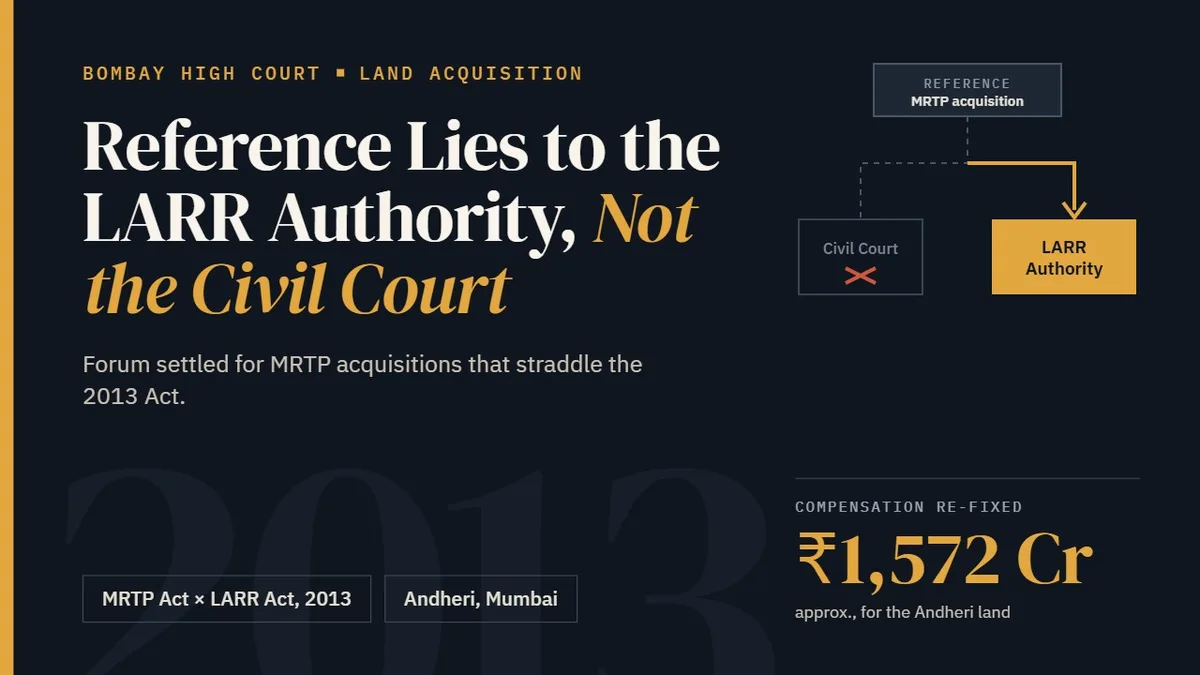
Key Proposition: The LARR Authority has jurisdiction to decide compensation references under Section 64 of the Act of 2013, superseding prior procedures established under the LA Act.
Catchwords:
- Land Acquisition – Jurisdiction – Question of maintainability of reference – Held, maintainable. (Para 70)
- Compensation – Assessment methods – Application of Section 26(1)(a) (Ready Reckoner Method) vs. Section 26(1)(b) (Sale Instances Method) – Determined. (Para 85)
- Deductions – Eligibility for TDR and fungible FSI – Evaluated. (Para 95)
Headnote: The case involved disputes over the jurisdiction of the LARR Authority and the method for determining compensation under the Land Acquisition Act. The Court upheld the LARR Authority's jurisdiction and ruled on the appropriate compensation methods, modifying the award to reflect these decisions accurately (Paras 70, 85).
Background / Synopsis
- The appeals arise from a compensation award for land acquired under the MRTP Act.
- The original award was challenged by both the claimant and MCGM.
- The impugned award enhanced compensation based on the LARR Authority's assessment.
- Key disputes included the applicability of Section 64 of the Act of 2013 and the method for determining market value.
Issues For Consideration
- Is the impugned award passed by the LARR Authority a nullity due to jurisdiction issues?
- Was the reference under Section 64 of the Act of 2013 maintainable?
- How should the market value of the subject land be assessed under the Act of 2013?
- Was the application of the residual land value technique appropriate?
- Was the enhancement of the quantum of compensation justified?
- Should the impugned award be interfered with?
- What is the quantum of compensation payable as per law?
Submissions Of Parties
Petitioner / Appellant:
Contended the LARR Authority had jurisdiction and the use of alternative assessment methods was valid.
Argued for substantial enhancements based on ready reckoner and sale instances.
Respondent / State:
Asserted the impugned award was without jurisdiction.
Challenged the validity of the compensation methods used
Re: Issue (i) – Jurisdiction of LARR Authority
Established that the LARR Authority had jurisdiction under the Act of 2013. No prejudice was caused by the change of forum.
Held: The award was valid (Para 70).
Re: Issue (ii) – Maintainability of reference
Affirmed the maintainability of the reference under Section 64 due to procedural changes post-2013.
Held: The reference was maintainable (Para 70).
Re: Issue (iii) – Assessment of market value
Determined compensation should be based on the ready reckoner method under Section 26(1)(a), not solely on sale instances, particularly due to the lack of sufficient data.
Held: The use of ready reckoner was justified (Para 85).
Re: Issue (iv) – Residual land value technique
Found the method improperly applied without adequate comparative land sale instances.
Held: Residual land value technique not applicable (Para 85).
Notable Observations: "The substance of the right to a remedy like a reference in such cases is the vested right, but the party seeking such a remedy does not have a vested right of choice of forum." (Para 57)
Decision & Directions
- Final compensation for the claimant set at ₹ 1,061,92,48,897.23 after adjustments for amounts already paid and interest.
- MCGM required to complete payment within 12 weeks.
- The original award by the Collector modified based on findings in this judgment.
Legal Provisions Discussed
- Right to Fair Compensation and Transparency in Land Acquisition, Rehabilitation and Resettlement Act, 2013 – Sections 24, 26, 30 and 69
- Maharashtra Regional and Town Planning Act, 1966 – Section 126
Precedents Cited
- Pune Municipal Corporation vs. Rajeev L. Sangtani and others, 2019 SCC OnLine Bom 1492 – Followed
- Girnar Traders (3) Vs. State of Maharashtra and others, (2011) 3 SCC 1 – Followed
Full Judgement / Attachment
Full Judgement
Frequently asked questions about Bombay High Court
- Where does the Bombay High Court sit and which areas does it cover?
- The Bombay High Court has its principal seat in Mumbai, with benches at Nagpur, Chhatrapati Sambhajinagar (Aurangabad) and Goa, and a circuit bench at Kolhapur that began sitting on 18 August 2025. It has jurisdiction over Maharashtra, Goa and the Union Territory of Dadra and Nagar Haveli and Daman and Diu. Established in 1862, it is one of India's three oldest High Courts.
- How do I search Bombay High Court cases across Mumbai, Nagpur, Aurangabad, Goa and Kolhapur?
- The official website, bombayhighcourt.gov.in, lets you pick the bench (Principal Seat, Nagpur, Aurangabad, Goa or Kolhapur) before searching case status, cause lists and orders. Judgements are also on the eCourts Judgments portal (judgments.ecourts.gov.in).
- What is the Original Side and Commercial Division of the Bombay High Court?
- On its Original Side, the court hears high-value civil suits arising within Mumbai city, and its Commercial Division hears commercial disputes under the Commercial Courts Act, 2015. It also hears arbitration petitions, company and tax appeals, including those from the ITAT Mumbai, Pune, Nagpur and Panaji Benches.
- What is a Letters Patent Appeal in the Bombay High Court?
- In many matters, an order of a single judge can be challenged before a Division Bench by a Letters Patent Appeal under Clause 15 of the Letters Patent. Commercial matters follow the Commercial Courts Act route instead. Against a final judgement, the route is a Special Leave Petition under Article 136, ordinarily within 90 days.
- How can White Collar Professional help with a Bombay High Court matter?
- Post your requirement on White Collar Professional to receive proposals from verified Advocates, Chartered Accountants and Company Secretaries, compare them, and pay securely through the platform. This page also tracks the latest Bombay High Court judgements and legal updates as they are reported.